
A World without Conflict?!
by Zoltán Dankó
Future-Proof Organization Practitioner -- Human leadership fuels high performance. If you have open mind, I help add open culture to leverage open-source - Change is risk: doing the same leads nowhere. Let's move on!
In a workshop some months ago, I asked the following question: How can a conflict help us? Of course, it was a tricky question, since I nudged the minds of colleagues to focus on potential good outcomes from a conflict. Some answers sounded like these: It can turn up new insights. It can help us realize new perspectives regarding the topic. It can uncover deep-rooted biases.
In the book, Conflict without Casualties by Nate Regier, there is a good description of the nature of the conflict. This diagram shows the essence:

At a first glimpse, it may describe where the problem’s root may lie. A conflict between what I want and what I experience. A massive emotional shock wave may be produced in an instant.
In my view, there is another layer that has been missed. Let us start to reconstruct what the background of a conflict is, and what is happening during the conflict?
I want to achieve a goal. It may be a goal in my private life, or at my workplace. I set out how to achieve this goal. If I need someone else’s help to the goal, I have to communicate with my goal-mates. Here starts the game. I explain my goal to others in my own words. This explanation hides a deeper structure in itself, and the linguistic phrase represents only a brief and succinct expression of this structure. Let’s dive in to show what I mean.
From our childhood on, we have learned a lot about our environment. Hundreds of thousands of beliefs have been accumulated in the minds that help us manage our lives. The majority of them won’t be conscious. Some of them we know. We regard them as rules we have to follow. We hardly question them. The beliefs may be cognitive, social, or fundamental to be able to function.
I have misread a sentence. I don’t realize the failure. I will remember it as I would have read it correctly. I will be ready to fight for it as I would have been right about it.
Having our deep-rooted beliefs, there is a strong alliance between beliefs and emotions. The habits, beliefs, and emotions are good friends. We know them, we believe them. We rely on them. Emotions deeply support our beliefs. If we want to force someone to change a belief, we will face strong emotional resistance. Let us modify the diagram above by applying the insights we got.
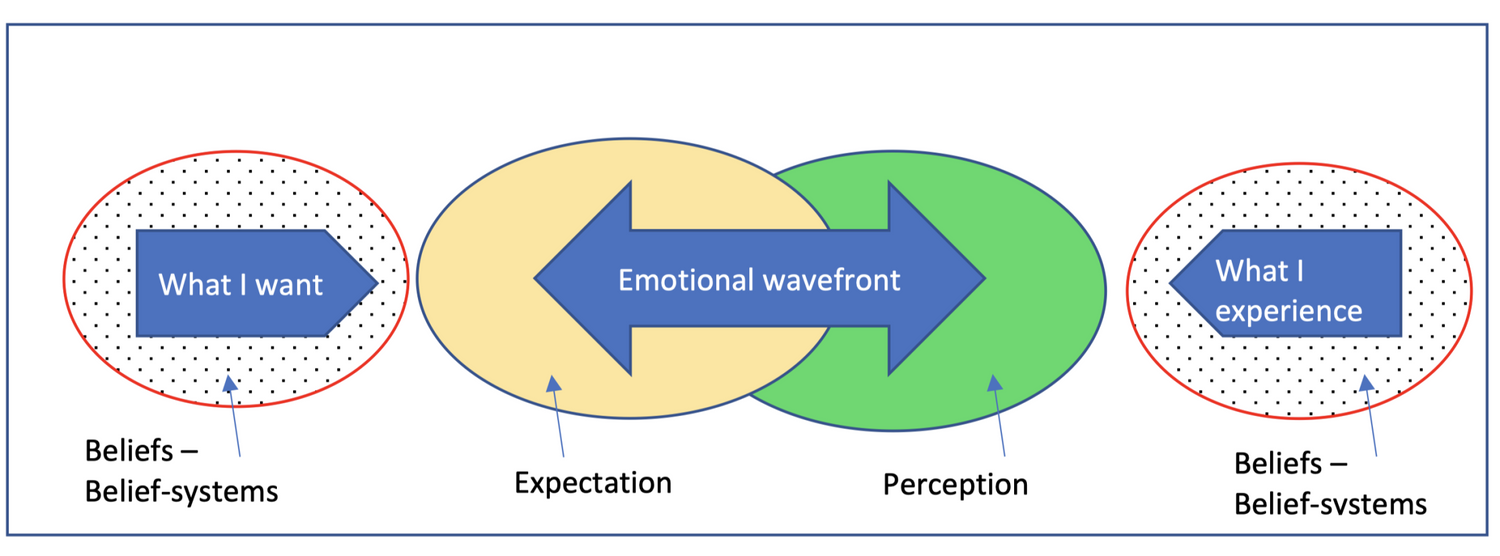
According to this model, several conclusions make it easier to understand the nature of the conflicts. What I want, will be influenced (consciously or unconsciously) by my belief-system. Based on the triggers of my belief system, I will create expectations (consciously or unconsciously). These conditions will determine my communications.
When we receive the response, it will take a shape or incorporated into the perception. It is a well-packed unit since the package contains the ingredients of the belief-system and expectations of the other party as well. Now, we have all the ingredients of a well-shaped conflict. Since this process contains a lot of unknown variables, our mind will be forced to initiate the prediction engine to fill the gaps. It should figure out why I want something, what I expect, my ability to formulate this in a possibly clear verbal phrase, complete all this sauce with emotional elements. When I receive the encrypted response, I have to decipher the underlying belief-system, the expectations, its relation to my will, the emotional content, and finally, deduce the conclusion.
Since the communication goes on instantly, we have a very short period of time to get done all of these processes. At this point, I am very much surprised why we do have so few conflicts around.:) Actually, there are many, but other conditional and behavioral controls override potential conflict situations, and conflicts remain hidden. We take a deep breath, we change the subject, etc.
I like practical things. How can we help us out of this mess? It seems to be obvious that one or two training won’t be enough. It will take a strong reflection on how I function in different situations, and I slowly can uncover my belief-system and expectations. I have to develop my communication arsenal, written and verbal as well since they are different worlds with different tools. I should impose on myself a tolerance membrane to slow down reactions. I have to skill myself in deciphering the responses by asking questions and requesting feedback on whether I understood it well. I have to identify my cognitive and social biases during this process, and either I get rid of them or at least know them. If we make the effort to get through this process, we will be someone whom people would like to communicate with.
"Never stay up on the barren heights of cleverness, but come down into the green valleys of silliness."
"Nothing is so difficult as not deceiving oneself." - Ludwig Wittgenstein